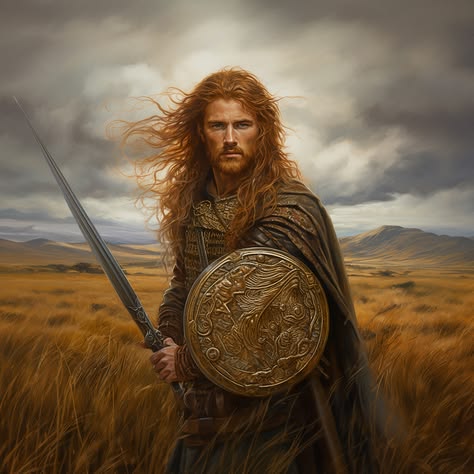
Lugh of the Long Arm
Lugh is the most complex of the chief Irish gods.
He is a study of duality and contradictions. Sometimes called the god of light, he was deceptive and manipulative and would lie, cheat and steal to defeat his opponents. He was jealous, but merciful. He was the god of justice that sometimes meted out rage. He straddles two mythic worlds. He is in the Ulster Cycle and the Mythic Cycle of Irish lore. Ethniu, his mother, was Formorian, an older darker sea-faring race in Ireland long before the coming of the gods. Cian, his father, was from the upstart race of the Tuatha De’Danaan, those very gods.
In the ancient book of Irish history, The Book of the Takings of Ireland, the Formorians and the Fir Bolg inhabited Ireland long before the ancient gods arrived. Eventually the arrival erupted into a brutal war, and Lugh’s grandfather, one-eyed Balor was considered the worst of the worst of the Formorians.
Because the Formorians, specifically Balor, imprisoned and finally murdered Lugh’s mother, Lugh had no love for them and dedicated his life to destroying Balor. During the final battle Lugh wielded a slingshot against Balor, killing him in with a rock to his one eye. With the death of Balor, the Tuatha De’Danann won the war. The Formorians and the Fir Bolg returned to their own lands.
Lugh had two homes. He became king at Moytura in County Sligo on the wild west side of Ireland where he killed Balor. He had a second home at Tara, in County Meath on the east side. Tara was the historical seat of the High Kings of Ireland.
Lugh means god of oaths. Some believe it means light, but modern scholars contest that view. Lugh (Pronounced Loo) was a law maker and giver. He wrote covenants and contracts. He molded society to his liking.
In addition to helping create a new society, he was a skilled warrior and indulged in metallurgy and the construction of weapons. He was called long arm because of Sleg or the Spear of Assal. It was so long, no enemy could get near him. It was unbeatable and could take the form of lightening. Sleg would always return to its master to fight another battle. . His sword was Fragarach, or The Answerer. Whomever he chose to point at had to tell the truth. His boat was called the Wind-sweeper and was faster than any boat on water. His horse, E’nbarr of the Flowing Mane could travel land and Sea. And finally, his greyhound, Failinis, always caught its prey, was invincible in battle and turned water into wine. He was rather handy to have around.
He was the father of the great Irish warrior Cu’Culainn, who single handily won the Cattle Raid of Cooley in the Irish epic, The Tain. Lugh came to his son to heal his wounds for three days. Revived, Cu’Culainn went on to fight and defeat his enemies.
After a 40-year reign, Lugh killed Cermait in a fit of rage. Cermait was son of the Daga and the illicit lover of Buach, one of Lugh’s wives. Lugh was sorrowful that his anger had caused him to kill Cermait. Cermait’s sons were devastated. They pretended to forgive Lugh and called for peace at a meeting on the Hill of Uisneach, the sacred center of Ireland. Lugh came unarmed. The three brothers nailed his foot to the ground, but Lugh was so strong he freed himself and dove into a nearby lake. The three followed and drown him. In the end, it was duplicity and lies that killed Lugh.
Even today the Irish celebrate the harvest with a festival on August 1 called Lughnasadh after this god.