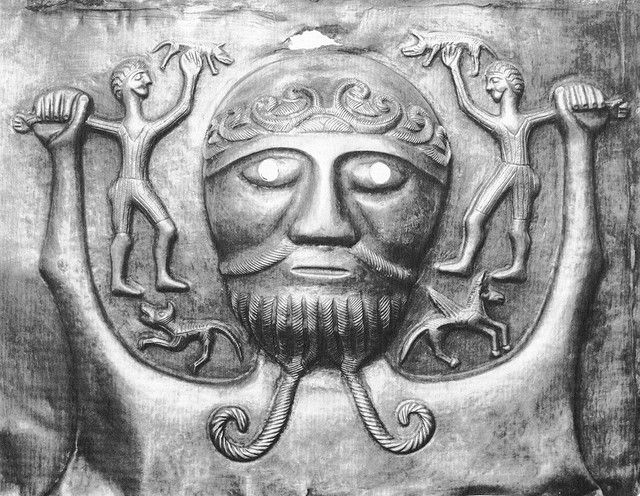
Dagda, chief of the Irish gods was round, loud and generous. He carried a club that could kill at one end and resurrect on the other. He played his oak harp to bring the changing of the seasons and carried a cauldron full of food. He was generous and had a hostel for weary travelers that also worked as a gate to Otherworld. It was a place of feasting and bragging about great deeds. No company went away from it unsatisfied. Dagda was skilled in many areas. He was the god of fertility and agriculture. He was a sage and a warrior. As a druid he knew the magical and the mysterious.
Most important, he was the father of the Tuatha Dé Danann, the supernatural, ageless humans who have at different times have been connected with either the fairy folk or with fallen angels.
Dagda ruled in a triune relationship with his two brothers, Nuadha, king of the gods, and Oghma a great warrior. The three brothers shared similar attributes and carried the title of chief and king at the same time. In many myths, the brothers coexisted together with Nuadha serving as King, the Dagda as chief/advisor, and Oghma as champion.
He married Morrigan, the goddess of war, who advised him and prophesied over him. He fought the Fomorians, gruesome giants that inhabited Ireland before the coming of the Tuatha Dé Danann. Sea raiders, Fomorians were led by the frightening king Balor. They represented chaos and destruction in the early settling of Ireland. Dagda fought two battles to drive them back to the sea.
Dagda was gigantic and oafish in demeanor and dress: ill-fitting leather wrapped at his waist exposed his big belly and he wound a woolen scarf around his head. He dwelt in the ancient monolithic mounds of the River Boyne valley, the Brú na Bóinne. These mounds are older than Stonehenge and the Great Pyramids. He fathered many children, among them Aengus, son of the river goddess Boann, the antagonist in my book “Gates of Erin”. His story weaves in and out of Irish geography and history until he died at Brú na Bóinne, finally succumbing to a wound inflicted by Cethlenn, Balor’s wife, during the final battle of Mag Tuired against the Fomorians.
Dagda ruled for eighty years before he died and was buried in the monolithic mounds he called home. A god who died? Was he a fallen angel or a larger-than-life human king, beloved by his people?