The Celtic Mythological influence on Irish Mythology was not as strong as is often believed. The two are very different.
The Irish developed a lucrative and extensive trade in bronze about 1700 BC. They would certainly have been exposed to the Celtic culture growing across central Europe, but it wasn’t until 500 BC that Celts migrated to the island. Even then, it was several centuries before the Celtic culture had much influence. The Celts brought the Iron Age to Ireland, but their gods and myths stayed in Gaul, which consisted of modern-day France, Belgium, northern Italy, western Switzerland and parts of the Netherlands and Germany.
The Irish had their druids and poets, but they were focused on the local territorial gods already in the Irish mythos. There is some cross over in function, but the Irish gods were different in nature and the relationships between gods and men were different.
The Irish are story tellers. Their stories were well documented and told over stewed meat and lots of ale. Their gods didn’t live on a high mountain, but in Otherworld which could be easily accessed. And the gods came and went joining in feasting and bragging about great deeds. Famous Irish warriors, like Cu’Culann and Fionn mac Cumhail, were sometimes gods and sometimes just very brave swordsmen. The gods would come and bandage the warrior’s wounds at night, so they could fight the next day. Men and gods intermixed in the literature. It should be noted that the early Irish monks took extensive care to record Irish mythologies as told by their elders, but they did write through the lens of Christianity.
Very little is known about the Celtic gods because the Celts didn’t record their history. It was a taboo to reveal that secret knowledge. The druids and poets spent 20 years training and memorizing their stories, sciences and arts. The only histories we have were written by their enemies. Julius Caesar penned his “Commentarii de Bello Gallico” from 58-50 BC. Some of the last druids were slaughtered by Romans on the Isle of Mona off the coast of Wales between 60 and 67 AD.
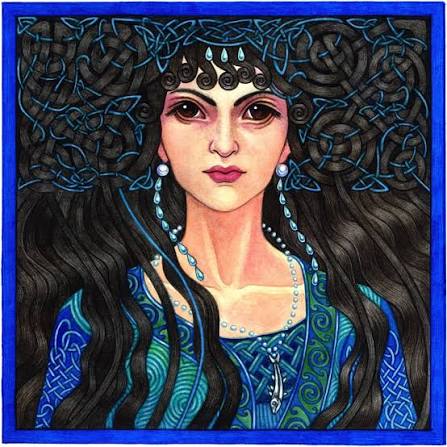
Some of the Celtic gods demanded human sacrifice: Esus, Teutatis, and Taranis. Most of their gods did not. Some archaeologists believe that humans were sacrificed by drowning in Irish bogs, but the evidence is not conclusive nor prevalent. The Irish gods represented the vagarities of weather and nature and sometimes the human soul. Boann, the goddess of the River Boyne was known to flood the plains of the river valley in anger. Her story rings across my book “The Gates of Erin.”
This image of Lady Boann was by done Thaila Took in 2017.